
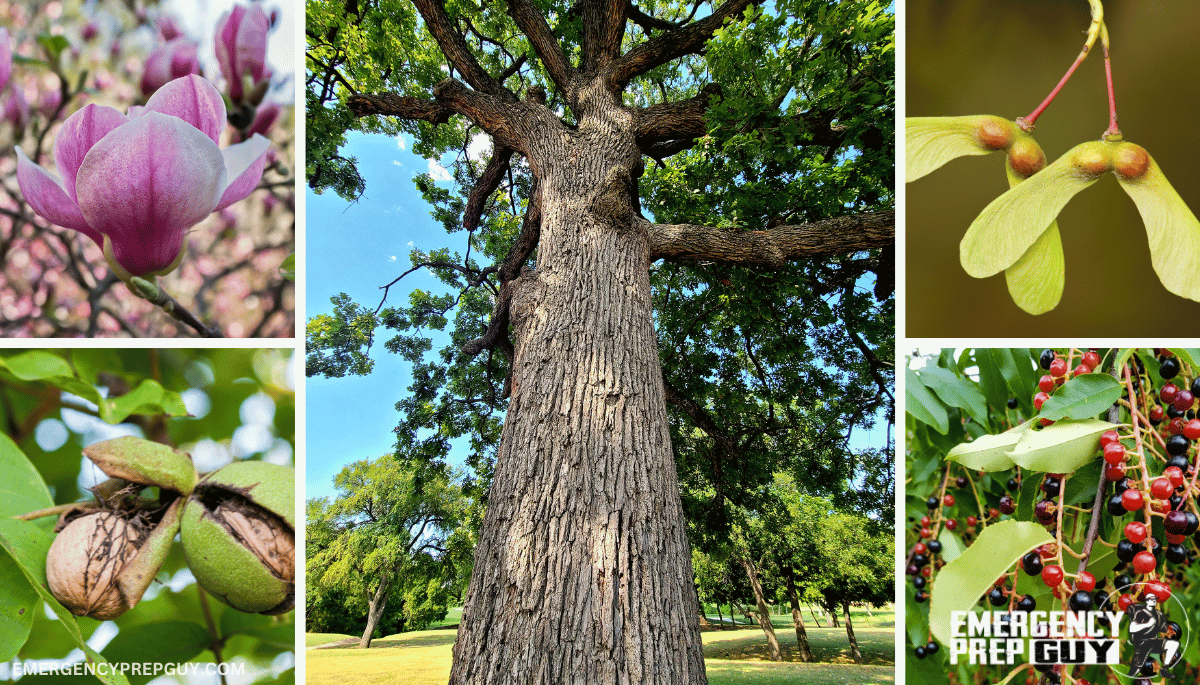
There are hundreds of edible tree species flourishing across the US. Unfortunately for foragers, many of these species only grow in specific states and climates. Learning about every niche species in your region – and elsewhere – can feel exhausting.
One of my favorite tips for beginner foragers is to instead focus on the trees with the widest growing range.
If you’re interested in foraging edible trees, here are some of the rare and incredibly useful species that grow in almost every state.
Forage These 7 Edible Trees Nearly Anywhere in the US
Learning more about these adaptable species will give you an arsenal of valuable survival knowledge. You’ll be able to identify food sources virtually anywhere in the country.
1. Pine Trees (Eastern, White, Ponderosa & Others)
How to Identify
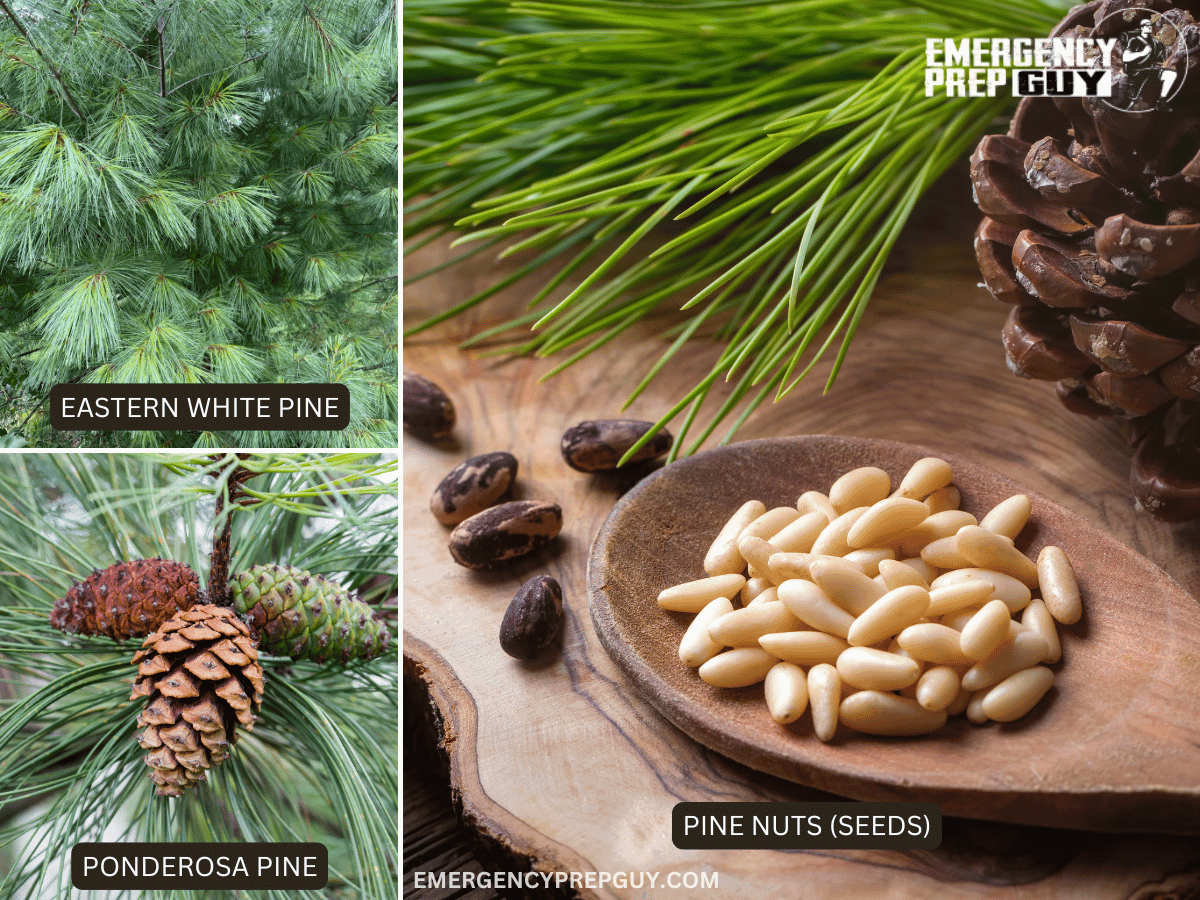
Look for evergreens with needle-like leaves typically bundled in groups. Eastern White Pine, for example, has five needles per cluster, while Ponderosa Pine has two or three. Pines produce woody cones, and bark texture ranges from smooth to rough, often featuring rectangular or scaly plates. If unsure, compare your findings with reputable foraging or forestry resources like the USDA Forest Service.
Parts to Forage & How to Use
- Needles: Brew into a vitamin-rich tea. Pine needle tea is often touted as high in vitamin C, though levels vary by species. And since they are evergreen, you can even forage during winter!
- Seeds (Pine Nuts): Collected from mature cones; remove the shell for a protein-rich snack. Note that some species have seeds too small to bother foraging, and a small minority have seeds that are inedible.
- Inner Bark (Advanced Survival Skill): Can be carefully scraped in dire emergencies, dried, and ground into flour. This method is traditionally documented in wilderness survival references, but overharvesting can harm the tree.
Where You’ll Find It
Pine trees thrive in diverse regions, from the cool, moist forests of the Northeast to the dry, mountainous areas of the West. Ponderosa Pines dominate much of the Rocky Mountain region, favoring well-drained, sunlit slopes, while Eastern White Pine populates mixed forests in the Great Lakes, New England, and parts of the Appalachian range. Generally, pines prefer sandy or well-drained soils and often form large stands in both wild and managed forest settings.


2. Oak Trees (Red, White, Black, Live & Others)
How to Identify
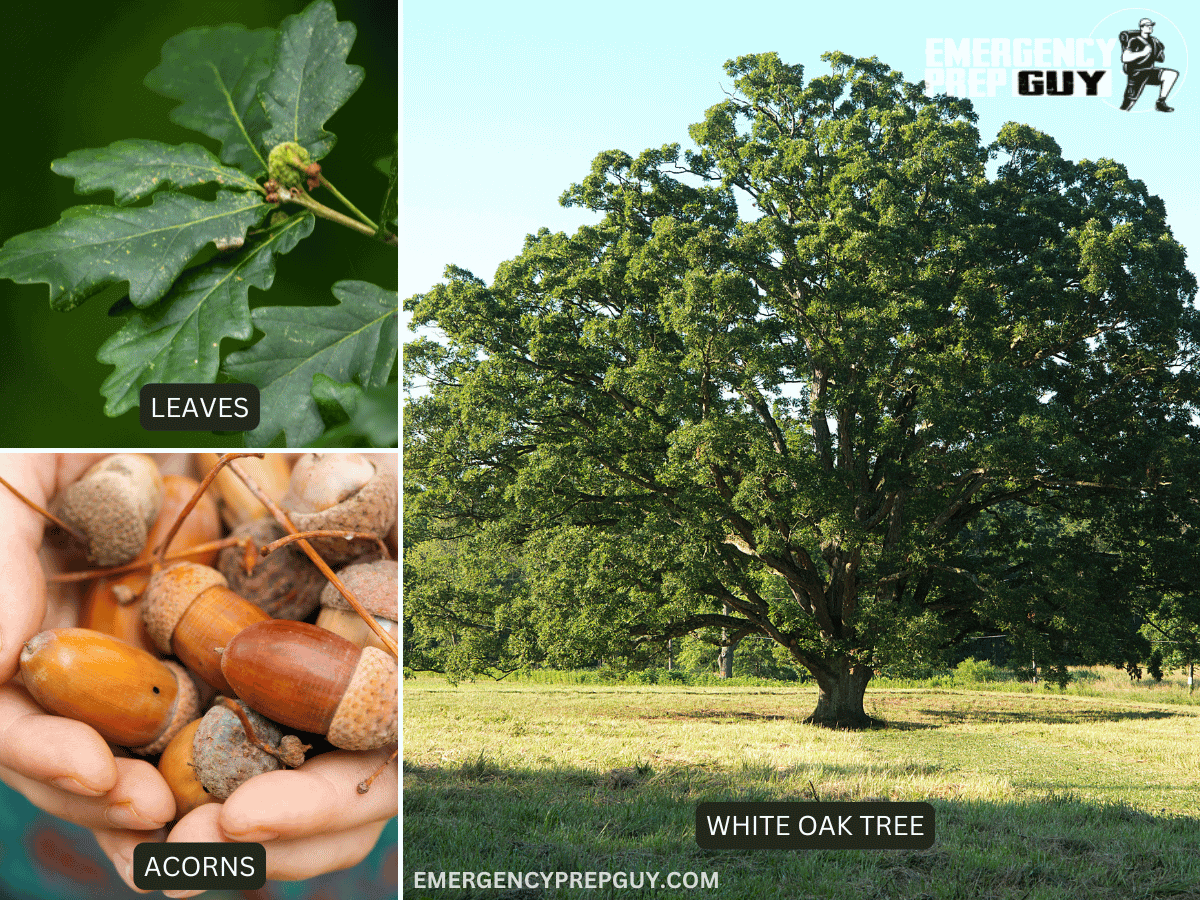
A typical oak leaf has several lobes, but the number of lobes, the size of the leaf, and the texture (whether it has hair on one or both sides) will vary from species to species. When grown in isolation the trees are broad with wide-spreading branches, but grow more narrow in oak forests. Most oaks are deciduous.
The easiest time to identify oak trees is in summer and fall when acorns begin forming and ripening. Keep in mind that harsh spring freezes can kill acorn growth, so if you suspect you’ve found an oak tree but can’t see any acorns, use those reputable sources to supplement your ID.
Parts to Forage & How to Use
- Acorns: Once they are leached to remove bitter tannins, acorns can be roasted, boiled, and ground down into flour. They are a great source of iron, potassium, and vitamins A and E. Prioritize species like white and burr oak, which take less time to process due to lower tannin content.
- Leaves: Young leaves can be added to dishes in small quantities, and used to make wine. Not all oak tree leaves are edible, and those that are can be harmful in large quantities, so harvest with caution (and plenty of research).
Where You’ll Find It
Oak trees are highly adaptable and able to thrive in a wide range of climates and soil conditions, but they grow best in rich, loamy soils and on forest floors. Wild and cultivated oak trees can be found across the US, but they are most heavily concentrated in eastern states, and harder to find in the west. If you’re looking for oaks in the western states, focus on live oak, California black oak, and Oregon white oak.
3. Maple Trees (Sugar, Red, Japanese, & Others)
How to Identify
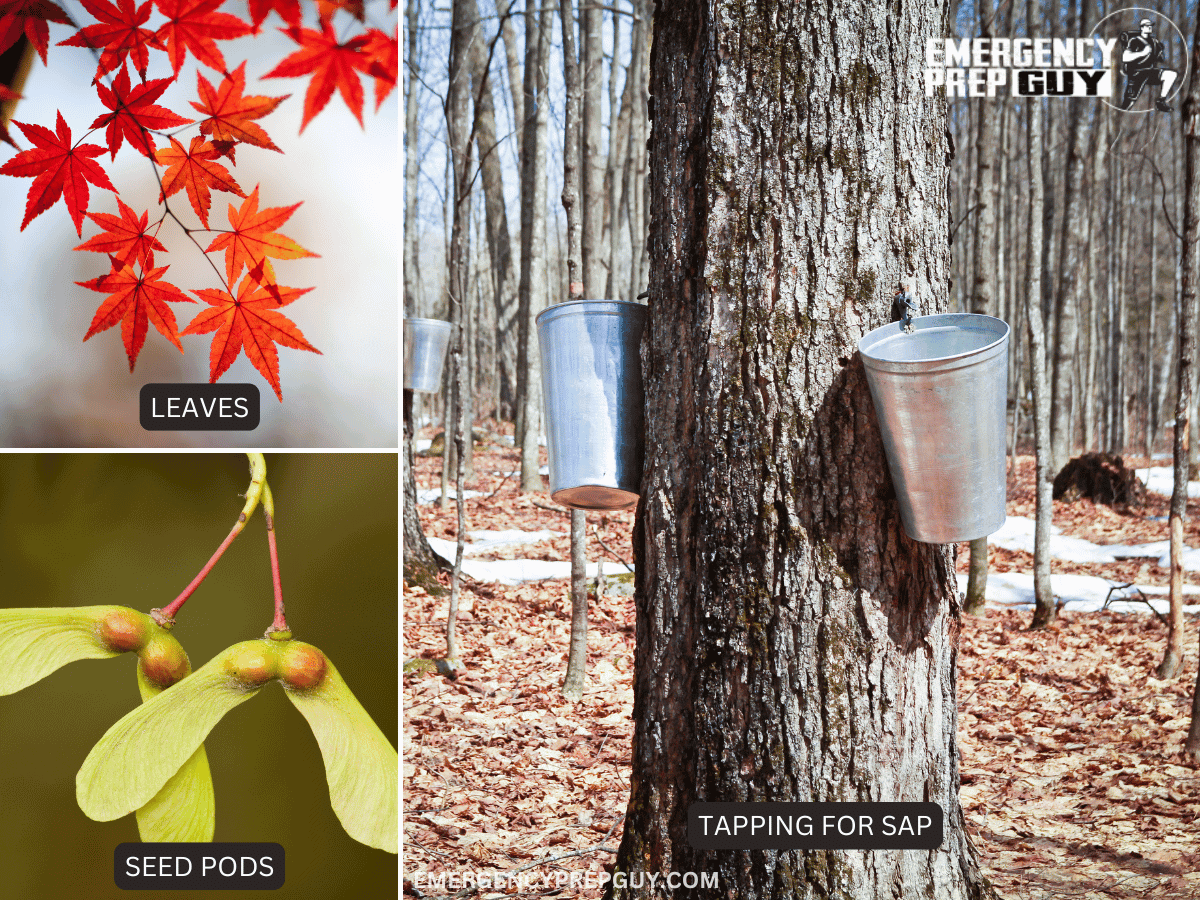
Most maple leaves are lobed in various ways, usually with sharp edges (like the sugar maple and silver maple) or round (black maple). Leaves usually have 3, 5, or 7 lobes. Look to the Canadian flag for a great example of the classic maple leaf shape! Maple seeds are sometimes called ‘helicopters’ due to their winged shape.
Bark, growth habit, and branching habits vary significantly across species, so I recommend using plant ID resources to differentiate the most common maple species like the sugar, red, silver, and Japanese maple.
Parts to Forage & How to Use
- Sap: By tapping a maple tree you obtain sap that can be boiled down into maple syrup. This will depend on the variety. The most common syrup species are the sugar, red, black, and silver maple.
- Leaves: Young maple leaves can be harvested in spring, and have a slight maple taste.
- Seeds: Separate the winged helicopter pod, and you’ll find the tiny maple seed, which is edible and can be eaten raw, boiled, or roasted.
Where You’ll Find It
Maples grow best in the north of the country, most notably the northeast, due to their propensity for cooler climates. Fortunately, there are heat-tolerant species – like the bigleaf, Armstrong, and vine – that can grow up to USDA zone 9. Most maple species, even in the wild, need moist, loose, well-draining soil. You are unlikely to find them in areas with dense, sandy, or rocky soil.
4. Black Cherry Trees (Prunus serotina)
How to Identify
In spring you can identify the black cherry by its attractive inflorescence of delicate white five-petaled flower. In summer, look out for the clusters of dark red and purple fruits hanging from 3-4 inch stems. Its dark gray and brown bark is covered in horizontal lenticels that look like cuts. Sometimes the texture of the bark looks scaly and ruptured.
Parts to Forage & How to Use
- Fruits: black cherries are edible and packed with flavor and sweetness. They can be eaten raw, but due to the small amount of flesh, they are best made into syrups, cordials, and baked goods.
- Please note that the leaves, seeds, bark, and twigs of the black cherry contain cyanide and are toxic.
Where You’ll Find It
Standard back cherry grows wild in most of the US, with the exception of some western states. If you’re in the west, keep an eye out for the southwestern black cherry and capulin black cherry varieties. In the Appalachians, it can be found growing as high as 5000 feet. It can grow in a variety of soil types but prefers cool, moist conditions. Black cherry needs full sunlight to thrive, so look out for these trees in open fields, meadows, woodland edges, and other areas with good air circulation and sun exposure.
5. Magnolia Trees
How to Identify
There are more than 360 species of magnolia, and their looks can change drastically across species, so it pays to use reputable resources to learn how to differentiate them. Fortunately, there are a few traits that most magnolia species tend to share – mainly their glossy, dark green leaves and white, pink, and sometimes yellow blossoms. Flowers are usually shaped like a bowl, with large cupped petals, or like a star, with much thinner oval-shaped petals.
Parts to Forage & How to Use
- Flowers: Magnolia flowers are fully edible, and they taste quite sweet and floral. They are high in vitamins A, C, and potassium. The edible flowers can be eaten raw or cooked but are best when pickled in a basic pickling brine.
Where You’ll Find It
If you’re looking for wild magnolias you’ll find them in the southeast of the US, where several native species flourish. Otherwise, you can find cultivated magnolias in public parks, gardens, and other green spaces. There are magnolia species like the star magnolia and the “Merrill” cultivar that grow in most states in the US. Magnolias grow best in moist, well-draining soil with an acidic pH.
6. Walnuts (Black, English, Butternut, & Others)
How to Identify
When looking for wild walnuts you will need to differentiate black walnut species from English walnut. While most English walnuts are cultivated in orchards, some can be found growing wild in western states.
There are major differences between the two types that can help with identification. Black walnut grows much taller (up to 100 feet) and has deep grey and black ridged bark and narrow leaves. English walnut, on the other hand, has smooth light-colored bark with very little texture, and oblong leaves. English walnut husks are green and the walnut shell is light brown, whereas black walnut husks are gray-green with dark brown shells.
Parts to Forage & How to Use
- Nuts: Walnut trees are foraged for their edible nuts. English walnuts have a much milder taste compared to black walnuts, but both can be used widely in sweet and savory recipes. Black walnuts also have a higher fat and protein content. Both are an excellent source of vitamins and healthy fats.
Where You’ll Find It
There are quite a few walnut species that can grow cultivated and wild throughout the US. So the species you can find will depend on where you live – for example, northern and southern California black walnut and Arizona black walnut trees can be found growing wild in the western and southwestern US, whereas common black walnut and butternut trees grow in the eastern US. Most walnut species grow best in rich, moist, well-draining soil on a site with full sun exposure. You won’t find them in shady areas with wet soil.
7. Ash Tree (White, Green, & Black)
How to Identify
There are a number of similarities among ash species that you can use to make an identification. They all have compound leaves, with each individual leaf containing 5 to 9 leaflets. The easiest way to identify ash trees is by their growth pattern – all ash trees have opposite branching, meaning their leaves, branches, and buds grow in pairs directly opposite each other. It’s a rare phenomenon shared by few other species.
Parts to Forage & How to Use
- Fruits, seeds, and shoots: all three can be eaten raw or added to soups and stir-fries. The fruits can be pickled and added to salads or made into a condiment.
- Please note that the ash tree population has been decimated by the invasive emerald ash borer. It is best to avoid foraging ash outside of survival situations.
Where You’ll Find It
Dozens of ash tree species grow wild in the US and different species can be found in almost every state. The two most common, white ash and green ash, grow prolifically across the northeast and midwest. Species like the Carolina, California, and Texas ash can be found in southern states, whereas green and black ash grow in more northern states.
Ash trees love moist soil, so keep an eye out for them in wetlands and along riverbanks and streams. All ash trees will thrive in rich, moist, well-draining soil, but different species will prefer specific climates.
Caution on Wild Foraging
Always positively identify any tree and its parts before consuming them – use multiple reliable field guides or expert resources, as look-alikes and toxic species exist. Some edible trees (such as black cherry) have poisonous parts, and others require specific preparation (like leaching acorns) to be safe.
Harvest sustainably and sparingly, especially from species under threat like ash, and only from clean, untreated areas free of pesticides or pollutants.
Foraging laws vary by location and land ownership; obtain permission where required. When in doubt, leave it out, and consult a qualified forager, botanist, or healthcare professional if you have any concerns about allergies, toxicity, or personal health.


